


 Copy Link
 Share
to X
Share
to X
 Share
to Facebook
Share
to Facebook
 Share
to LinkedIn
Share
to LinkedIn
 Share
on Email
Share
on Email
“Why?”
“Why?”
“Why?”
“Why?”
…and on and on.
Sure, sometimes our kids’ curiosity can be a bit… challenging. But these endless strings of questions highlight a few important things: Kids are naturally curious, and how far their curiosity goes often depends on our appetite for entertaining it.
Curiosity in kids comes from both directions: their innate sense of it and their nurtured exercise of it. Curiosity is both a “trait” and a “state.”
It’s one of the motivational forces behind how kids learn, solve problems, explore new ideas, and adapt to unfamiliar situations. Long before children can articulate complex thoughts, curiosity drives them to test boundaries, experiment, observe outcomes, and try again.
It’s how they start to make sense of the world.
Yet curiosity is often misunderstood. Many adults assume it’s either a fixed personality trait (“Some kids are curious, others aren’t”) or something kids naturally grow out of as they get older. But research (and everyday experience) indicates neither is true.
Nurture is a kids’ app that develops Life Readiness skills such as creativity, curiosity, and critical thinking. All the more important in the age of AI, they're developed through fun, interactive, story-driven adventures. Nurture Academy — that’s where you are right now! — is for parents learning what it takes to raise smart, happy, and resilient kids in our increasingly digital world. We’re glad you’re here!
Read on, then discover how Nurture works or get the app.
Curiosity Can be Taught — It’s Not a “Have or Have Not” Trait
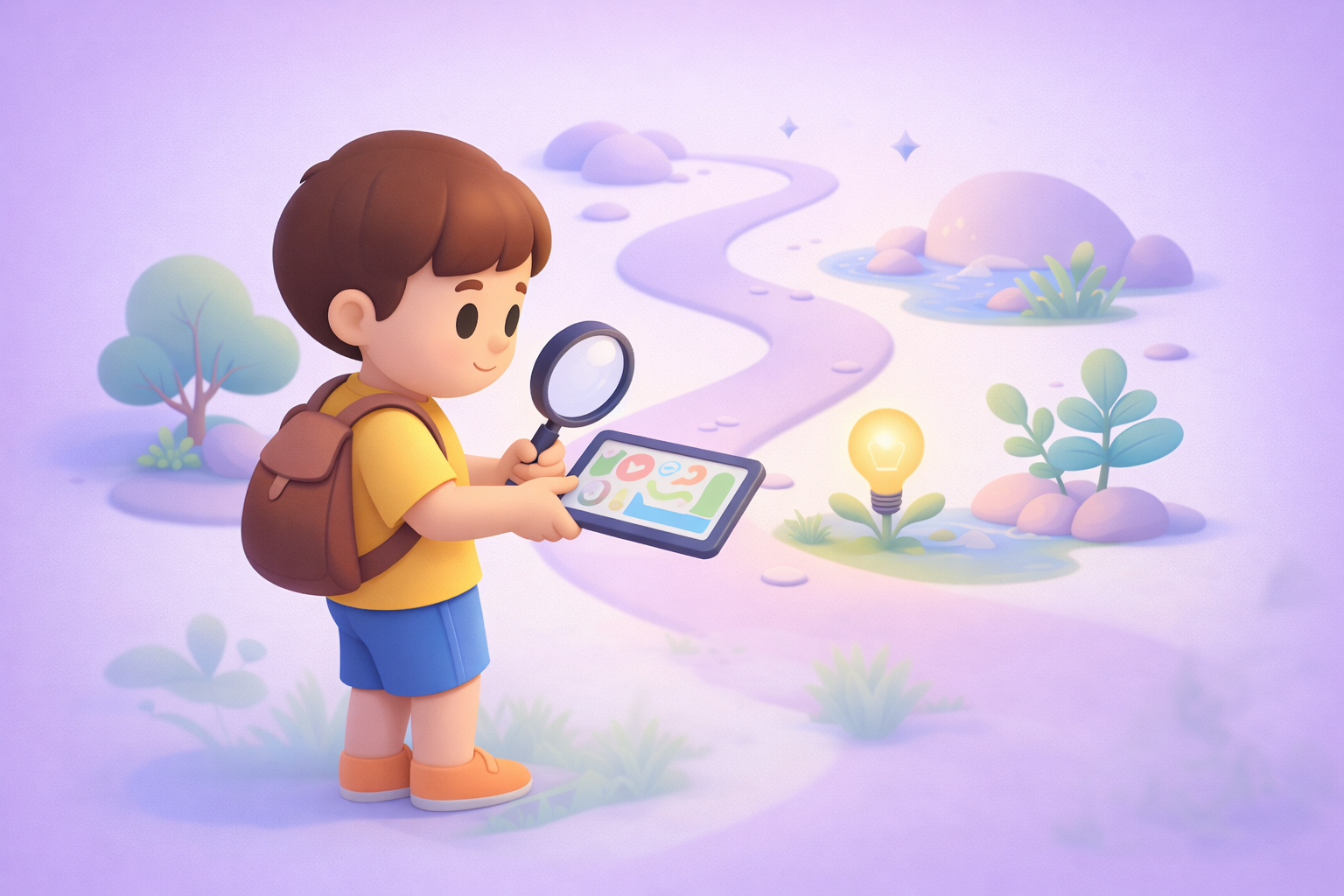
If curiosity is both a trait and a state, or a skill, how do we identify and develop it?
First, we need to understand their curiosity to assess their baseline capacity. Some people have more inherent drive toward it. But you can also cultivate curiosity as a habit. And you can support an environment that spurs and rewards it. A kid’s environment is either going to encourage or suppress their curiosity.
This is because curiosity works in two ways. It can be a trait, meaning some children may show a stronger natural tendency toward exploration. But it’s also a state, meaning something that fluctuates and grows with practice and intentionally adopting that mindset. How curious a child is often depends less on who they are and more on how much space they’re given to wonder, explore, and follow their interests.
That’s why early childhood, especially ages 4–7, is such a critical window. During this period, kids are building the cognitive and emotional foundations that support lifelong learning. When curiosity is encouraged, children learn how to tolerate uncertainty, persist through challenges, and stay engaged even when answers aren’t immediate. When it’s discouraged (that is, rushed, dismissed, or overly structured), curiosity can quietly shrink.
Curiosity is a foundational life skill, not a nice-to-have. It’s something that can be supported, protected, and practiced, both on and off screens.
And yes, that includes video games.
When designed thoughtfully and used intentionally, digital games can offer powerful opportunities for exploration, experimentation, and discovery. They can give kids safe spaces to try ideas, see what happens, and keep going — all core ingredients of curiosity.
What Curiosity Looks Like in Kids and Why it Matters for Their Future
Curiosity emerges in infancy and tends to amplify through toddlerhood, as anyone who’s discovered just how much babyproofing you need to do can tell you.
As kids grow past their toddler years, their curiosity tends to happen in the lane of specific interests. My oldest child was super into space. My middle child is super into dinosaurs. My youngest child is really into cars and airplanes, and other things that move. They’ll follow their curiosity deep, far, and wide into those topics, and sometimes discover a new interest that’s related to those. But it’s not a limitation, it’s practice.
They’re learning how to:
- Seek information independently
- Tolerate uncertainty
- Persist through confusion or challenge
- Build knowledge over time
They’re also learning who they are, what interests them, and what makes them different and unique. Curiosity can be just as much about exploring the world around them as it is about exploring their own minds, perspectives, and feelings. Do they like more creative activities, or something more structured? Do they like fast-paced adventures or slower, calmer discovery? It’s about the things that excite them but also how they like to learn, engage, play, and interact with the world, people, and scenarios they encounter.
In kids, curiosity shows up as:
- Exploring
- Experimenting
- Persisting
- Questioning
Learning and practicing curiosity as a child and carrying that appreciation into adulthood can yield benefits well into adulthood. Research on older adults suggests that actively engaging with the world through curiosity is associated with better brain health and even longer life. The study emphasizes the “state” of curiosity (intentionally adopting a curious mindset) as even more beneficial than the “trait” (one’s natural capacity for curiosity).
That’s why early curiosity matters so much. It’s not about mastering facts early. It’s about building a habit of engagement that lasts.
Caregivers are an essential element in developing kids’ curiosity. Do they nurture it, strengthen it, or write it off as annoying or frivolous? What caregivers have to remember is that early curiosity, even if it’s focused on a single topic, is the exercise growing minds need to embrace and expand their curiosities later in life.
As active shapers of our kids’ curiosity trait and skill, caregivers can:
- Model curiosity
- Respond and encourage questions
- Help children discover what interests them
- Celebrate their uniqueness
We can also invite kids to explore an interactive, nearly endlessly creative, and exploratory way to express and flex their curiosity: video games.
How Video Games Can Support Curiosity Development
One powerful (and often misunderstood) way kids can practice curiosity is through video games.
Games are spaces for exploration, a key tenet of curiosity. Some of their core mechanics are perfectly aligned with nurturing curiosity:
- Creative expression
- Open worlds
- Branching narratives
- Open-ended goals
- Unlimited “do-overs”
Video games lower the emotional and social costs of being “wrong,” so kids can be curious to try things in new ways, take chances, and turn corners even when they’re unsure of what comes next. It’s a safe laboratory for experimentation.
For instance, my kids love Kerbal Space Program, a game that invites players to design and launch spacecraft. The game doesn’t tell kids exactly how to succeed. Instead, it encourages trial and error — building, launching, failing, adjusting, and trying again. In the process, kids naturally engage with physics, problem-solving, and persistence, all driven by curiosity rather than instruction.
Research shows that curiosity in gameplay isn’t an unintended benefit, but a measurable dimension of the experience. There are multiple concrete facets of curiosity that designers can intentionally use. Games that tap into those curiosity dimensions tend to keep players engaged longer than those that do not.
Showing Up Curious
However, players can also imbue the games they play with curiosity if they play with that intention. Other research suggests that curiosity in games doesn’t come from a single genre or formula. Instead, players report feeling curious when games leave room for exploration, unanswered questions, and self-directed discovery, especially when they approach play with curiosity.
So not only can a video game inspire curiosity, but it can also feed an existing appetite for curiosity. It works both ways. Curiosity can also be encouraged and amplified when we co-play with our kids, commend their curiosity, and demonstrate our own.
Importantly, a game labeled as educational isn’t the deciding factor in whether it helps players foster their curiosity. Teaching math or science through a digital platform has its own benefits, but it’s not necessarily going to inspire a kid to start exploring.
We can lean into the more open-ended games that reward exploration to help develop skills beyond the surface-level goals and discover the true magic of exploring a new land of magical and mystical creatures. Can you tell that fantasy games are one of my family’s favorite curiosities?
In some ways, nearly all games foster curiosity. Some might be exceptionally suited for it, even designed to support it, but the opportunity to flex their free-thinking nature, try new things, and learn from the results builds curiosity even in the quickest of moments.
How to Nurture Curiosity, On- and Off-Screen
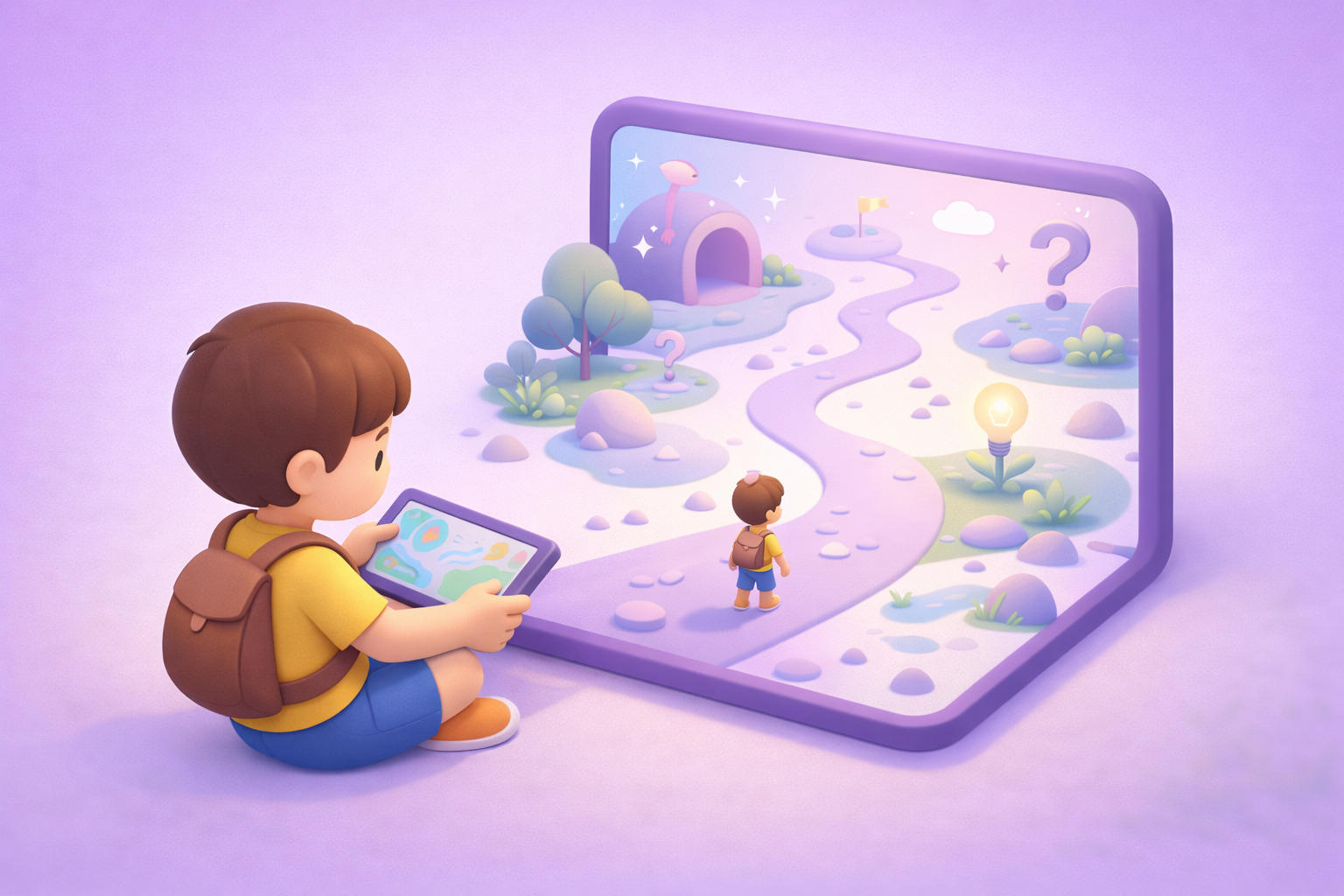
Developing curiosity doesn’t mean we, as caregivers, always have the answer — or a new game on hand — but it does mean we ourselves remain curious, too. Remember the phrase, “let’s find out,” and deploy it whenever you want to spur that curiosity. Be comfortable with not knowing, and excited to find out, so they are too.
You are their role model. Stay curious, open, and encouraging. Stay strong through the whys. Kids watch how adults respond to uncertainty, questions, and mistakes. Staying curious yourself sends a powerful message: learning doesn’t stop when you grow up.
Other ways to support curiosity include:
- Following your child’s interests rather than steering outcomes
- Asking open-ended questions instead of testing knowledge
- Balancing structure with freedom to explore
- Treating screens as tools for discovery, not rewards or babysitters
Curiosity grows best when kids feel safe to wonder, experiment, and change their minds. That means knowing when to step in and when to step back. “What do you think?” is a particularly handy phrase to fall back on!
Curiosity Is a Muscle: Give Kids Space to Exercise It
Curiosity grows through use, not instruction.
Kids don’t lose curiosity because they grow older. They lose it when exploration feels discouraged, rushed, or risky. Thoughtful play (digital and non-digital) helps keep curiosity alive by giving kids room to ask, try, and wonder.
It isn’t that we, as caregivers, need to do more. Often, we just need to do things a little differently: slow down, follow the child’s lead, and make space for curiosity to unfold.
FAQs: Developing Kids’ Curiosity
Can curiosity really be taught to kids, or is it natural?
Curiosity is both innate and learnable. While some kids show a stronger natural drive, curiosity can be supported and strengthened through environment, encouragement, and practice.
How do I know if a game is encouraging curiosity or just holding attention?
Games that support curiosity invite exploration, choice, and experimentation — not just repetition or rewards — and encourage kids to ask “what happens if…?”
Research on player experiences suggests that curiosity isn’t limited to specific ‘curiosity-focused’ games. When players actively seek novelty and exploration, many games can spark and serve curiosity depending on how they’re played and supported.
Can too much structure reduce curiosity?
Too much structure can limit exploration. Curiosity thrives when kids have freedom to try, adjust, and discover without pressure to perform.
What if my child doesn’t seem curious at all?
Start by observing what already captures their interest. Curiosity often shows up in focused, quiet ways. Following that thread is more effective than pushing new topics.
How can I support curiosity without overwhelming my child?
Stay present, ask open-ended questions, and model curiosity yourself. Small moments of shared exploration matter more than constant stimulation.


