


 Copy Link
 Share
to X
Share
to X
 Share
to Facebook
Share
to Facebook
 Share
to LinkedIn
Share
to LinkedIn
 Share
on Email
Share
on Email
Most parents know they should talk to their kids about online strangers. Far fewer feel confident about how to actually do it — what to say, how to frame it, and how to avoid either frightening a 5-year-old or talking completely over their head.
Here's the good news: this conversation doesn't have to be a formal sit-down or a scary lecture. At ages 4 to 7, it works best as a series of small, natural moments threaded through everyday life. The goal isn't one perfect talk. It's many small ones that build a consistent, confident foundation.
Before You Start: Rethink "Stranger Danger"
The classic "don't talk to strangers" rule was built for a world where strangers were easy to spot: unfamiliar faces in physical spaces. Online, that rule breaks down almost immediately.
For children in this age group, a more useful frame is what child safety educators sometimes call tricky people: focus not on whether someone is a stranger, but on whether their behavior follows the rules. A stranger who respects boundaries isn't the concern. A person — known or unknown — who asks for private information, tries to keep things secret from your parents, or makes your child feel uncomfortable is.
This shift matters because it gives children something concrete to act on, regardless of whether they've technically "met" someone before.
How to Open the Conversation (By Age)
Ages 4–5: Keep It Simple and Story-Based
At this age, abstract concepts don't land well. What works is story and analogy. Kids this age understand costumes, disguises, and the idea that things aren't always what they look like — use that.
Try this:
"You know how in some stories, a character might wear a disguise and pretend to be someone they're not? Sometimes people online do something like that. They might say they're a kid your age when they're actually a grown-up. That's why we have a rule: we don't answer questions or share information with people we don't know in real life."
Then follow it immediately with the action step:
"If anyone online ever asks you questions about where you live, your name, or your school — or asks you to keep a secret from me — you close it and come find me. You'll never be in trouble for telling me."
Don't probe for questions at this age. Plant the seed and move on. Repetition over time matters more than depth in a single conversation.
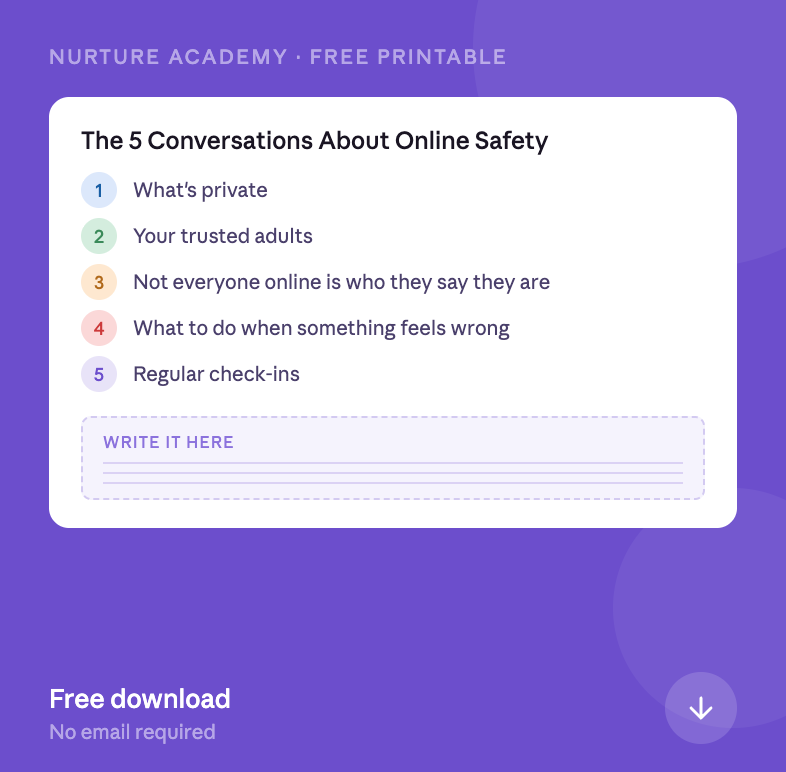
Free printable: The 5 Conversations About Online Safety Five age-adapted scripts (one for each conversation), a printable trusted adult list your child can fill in, and a quick reference for regular check-in questions. One page.
Ages 6–7: Add Context and Practice
By six and seven, children can hold more nuance. They understand that people can lie with intention. They're starting to use devices more independently. This is the right moment to be slightly more specific — and to practice.
Try this:
"When you play games online, sometimes you might talk to other players. Some of them are kids, and some of them might be grown-ups pretending to be kids. We can't always tell just by looking. So we have some rules about what we share and what we don't."
Then go through the private information list together: your full name, where you live, your school name, your phone number, photos. Make it a conversation, not a recitation.
Then practice it:
"Let's play a quick game. I'm going to pretend to be someone in your game. Ready?" (Play the scenario of someone asking for personal information.) "What do you do?" The answer: close it and tell me.
The role-play isn't about catching your child out. It's about making the response automatic so it doesn't require real-time decision-making in a moment of pressure.
Three Things to Say in Every Version of This Conversation
Regardless of age, three messages should appear in every iteration of this talk:
1. You will never be in trouble for telling me.
Children often stay silent about uncomfortable online interactions because they're afraid of losing screen time or being blamed. Make the safety net explicit and unconditional. Reinforce it regularly, not just during safety conversations.
2. If something online makes you feel weird, that feeling is important.
Kids have intuition. A 5-year-old can feel that something is off without being able to articulate why. Validate that feeling as useful information. "If anything online ever makes you feel confused, uncomfortable, or like you want to hide it from me, that's your signal to close it and come find me."
3. This isn't about being scared. It's about being ready.
Framing matters enormously. The goal isn't a child who is anxious about technology. It's a child who feels capable and prepared. Every version of this conversation should end on confidence, not fear.
How to Keep the Conversation Going
A single talk fades quickly. What actually builds lasting habits is regular, low-stakes check-ins woven into normal life.
A few that work naturally:
- After screen time: "Did anything happen online today that felt weird or made you unsure?"
- When setting up a new app together: "Why do you think this app wants to know your birthday? Does it need that?"
- When your child tells you about a game or video: "Who were the other players? Did anyone say anything strange?"
These questions normalize talking about online experiences the same way you'd ask about what happened at school. Children who are asked regularly are far more likely to bring the important things when they arise.
For the full set of safety concepts to build alongside this conversation, see our internet safety tips for kids, including the specific rules around private information, trusted adults, and what to do if something goes wrong. And if you want to help your child practice these skills in a context they'll actually enjoy, Nurture's DD403 adventure, Tomatoes Tomorrow, builds the online stranger and trusted adult skills through interactive story play — making the lesson feel like an adventure rather than a warning.

Giving your child the experience first makes the conversation much easier. In Nurture's Tomatoes Tomorrow adventure, your child plays through an online stranger encounter and makes the call so when you talk about it afterward, you're reinforcing something real.
FAQ
How do I talk to my 5-year-old about online strangers?
Keep it simple, story-based, and non-scary. Use the idea of a disguise: "Some people online pretend to be someone they're not, just like wearing a costume." Establish one clear rule: private information (name, address, school) stays private, and if anyone asks for it online, they close the app and tell you immediately. Repeat this in small doses over time rather than trying to cover everything in one conversation.
What should I tell my child about talking to people online?
Focus on behaviors rather than categories. Instead of "don't talk to strangers," teach your child to notice red-flag behaviors: asking for personal information, wanting to keep things secret from parents, or making them feel uncomfortable or pressured. Explain that these behaviors are the signal — regardless of whether the person seems friendly or familiar.
How do I explain online safety without scaring my child?
Frame it as preparation, not danger. Use language like "we have a rule" rather than "there are bad people." Focus on what your child can do (close it and tell me) rather than what might happen. End every safety conversation with a confidence statement: "Now you know exactly what to do, so you're ready."
At what age should I start talking to my child about online safety?
As soon as your child has any access to a device that connects them to other people — games with chat features, video calls, apps with accounts. For most families, this means starting at age 4 or 5 with simple, brief conversations and building from there as the child grows.
How often should I have this conversation?
Frequently, but lightly. One big talk is far less effective than many small check-ins. Ask a question after screen time, talk about a news story, role-play a scenario during a car ride. The goal is making this a normal, ongoing part of how your family talks about digital life, not a one-time event.


