


 Copy Link
 Share
to X
Share
to X
 Share
to Facebook
Share
to Facebook
 Share
to LinkedIn
Share
to LinkedIn
 Share
on Email
Share
on Email
Most of us grew up with a simple rule: don't talk to strangers.
It was easy to picture. A stranger was someone you didn't recognize — a face you'd never seen before. The rule made sense in a physical world where strangers looked like strangers.
Online, that's no longer true. And that gap between the old rule and the new reality is exactly where young children are most vulnerable.
Why Online Strangers Are Different
In digital spaces, a stranger can show up looking like another kid your child's age, sharing the same interests, using friendly language, and fitting right in. They can appear inside a game your child already loves, in a chat connected to a show they watch, or through a video call platform used for family. There is no visual cue, no gut instinct triggered by unfamiliar body language, no parent nearby to notice something feels off.
Research from the National Center for Missing and Exploited Children consistently shows that online predators succeed not by seeming scary, but by seeming safe. They build familiarity over time. They ask small, innocent questions. They find common ground.
For kids ages 4 to 7, who are only just beginning to distinguish between people they know in real life and people they've encountered on a screen, this is genuinely tricky territory. A character in a game who's chatted with them five times can feel like a friend. The digital context doesn't automatically register as "stranger" the way a face on the street does.
This isn't a failure on the part of your child. It's developmental. Young kids are wired to connect, to be open, to respond to friendliness. Our job as parents isn't to override that instinct. It's to give kids the tools to navigate it safely.
The "Strange Tomato" Problem
In Nurture's DD403 adventure, the crew encounters a character that looks just like one of the tomatoes they're trying to help — except it's not. It's a stranger disguised to blend in. When it makes contact, it immediately starts asking for personal information.
Boing knows what to do. She hangs up.
That moment captures something that's genuinely hard to explain to a 5-year-old in the abstract: online, someone can look like they belong when they don't. The disguise isn't a Halloween costume. It's a profile picture, a username, a tone of voice that sounds familiar. By watching a character navigate that situation, kids build an intuition that's much harder to build through a conversation alone.
Play-based learning works this way. According to research on digital safety and children, kids internalize safety concepts more durably when they encounter them in a story context, where emotion and experience are involved, rather than through instruction.
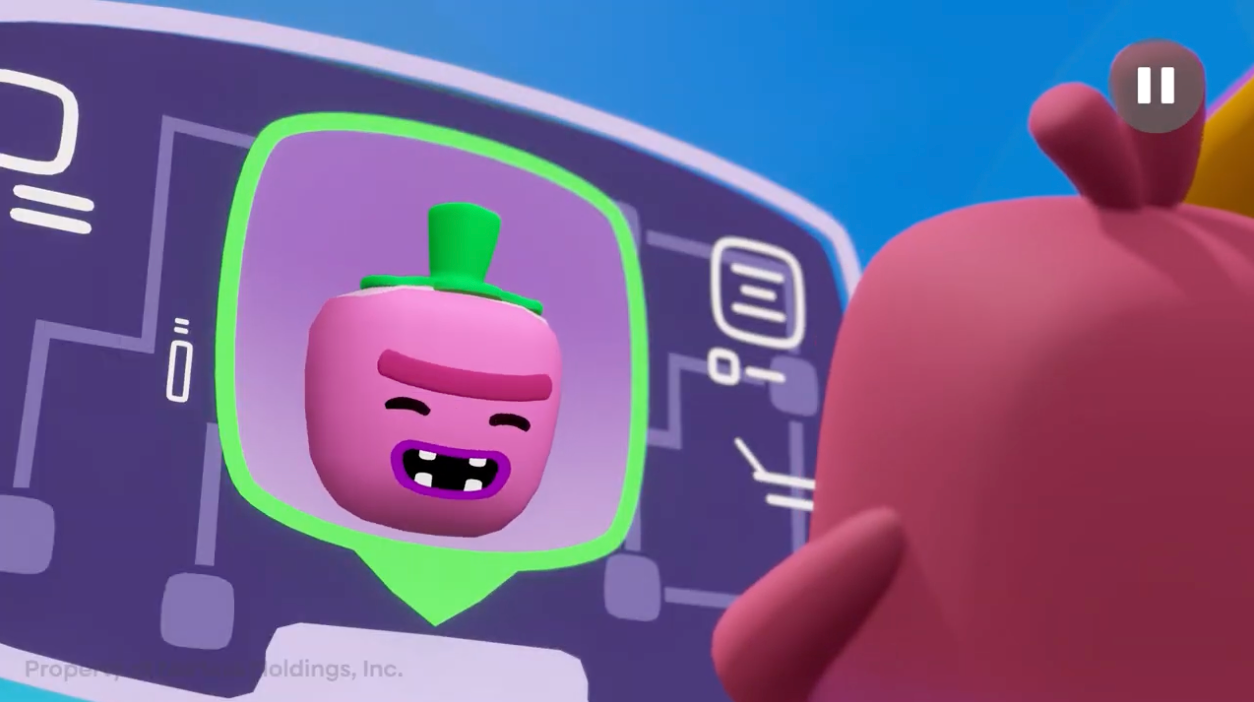
Explaining online stranger danger is hard. Experiencing it through a story is different. In Nurture's Tomato Imposter adventure, your child plays through the moment a suspicious stranger appears and practices the right response in a safe, engaging context.
What to Teach Kids About Online Strangers (Ages 4–7)
For young children, the concept of online stranger danger doesn't need to be frightening or complicated. It needs to be concrete and practiced.
Here are the core ideas to build, in age-appropriate language:
"Some people online aren't who they say they are."
You don't need to go into detail about why. For a 5-year-old, it's enough to establish the concept: the person you're talking to in a game might not actually be a kid. They might be pretending. Just like in stories, sometimes things aren't what they look like.
"Your private information is just for people we know in real life."
Private information includes your full name, where you live, what school you go to, your phone number, and any photos of yourself. Help your child understand that sharing this information, even with someone who seems friendly, is not something they should do without asking you first.
"If someone online asks for private information, you hang up or close it and tell me immediately."
This is the action step. Practice it explicitly. Role-play it. "What do you do if someone in your game asks where you live?" "What do you do if someone you've never met starts messaging you?" The answer should be automatic: close it and tell a trusted adult.
"You will never be in trouble for telling me."
This matters more than parents sometimes realize. Children often hesitate to disclose online interactions because they're afraid of losing screen time, or of being blamed for talking to someone they shouldn't have. Make it explicit and unconditional: telling you is always the right move, and it will never result in punishment.
Age-by-Age Framing
For 4 to 5 year olds, keep it simple and story-based. "Sometimes people online pretend to be someone they're not, just like a costume. If someone online asks you questions that feel like grown-up questions, you come and tell me right away." That's really enough at this age.
For 6 to 7 year olds, you can add more context. Start a conversation about the difference between people they know in real life versus people they've only "met" on a screen. Introduce the concept of private information clearly. Practice the action step: close it, tell an adult.
Neither conversation needs to be heavy. The goal is awareness, not anxiety.
Conversation Starters
If you're not sure how to open this up with your child, these prompts can help:
- "Have you ever talked to anyone in a game or on a video call who you didn't know in real life?"
- "What would you do if someone you'd never met started asking you questions?"
- "Let's make a list of the things that are private — things we only share with people we really know."
- "If something on your tablet ever made you feel weird or confused, who would you tell?"
That last question connects directly to the idea of a trusted adult — and it's worth making sure your child has a clear answer before they ever need one.
Empowerment, Not Fear
The research on effective online safety education for young children consistently points in one direction: fear-based framing doesn't work well, and can even backfire by making children anxious about technology rather than capable of using it safely.
What works is building confidence. A child who knows what private information is, knows what to do when something feels off, and knows exactly who to tell — that child is genuinely prepared. They're not scared of the internet; they know how to move through it.
This is a core part of what digital citizenship looks like for young children: not rules enforced from the outside, but values and skills built from the inside. For more on building that foundation, see our complete list of internet safety tips for kids ages 4 to 7.
FAQ
How do you explain online stranger danger to a young child?
Keep it concrete and story-based rather than scary. Tell your child that some people online pretend to be someone they're not, just like wearing a costume. Explain that private information (their name, address, school, and photos) is only for people they know in real life. Practice the action step together: if someone online asks for private information or makes them feel uncomfortable, they close the app and tell a trusted adult right away.
What information should kids never share online?
Children should never share their full name, home address, phone number, school name, or photos of themselves with anyone they haven't met in real life. This applies to games, chat features in apps, video calls with unfamiliar people, and any platform where someone they don't know in person might be present.
What should a child do if a stranger contacts them online?
Close the app or game immediately and tell a trusted adult. Kids should not try to figure it out on their own, respond to see what happens, or wait to tell someone. The action should be automatic: close it and tell. Reinforce that they will never be in trouble for telling you.
At what age should I start talking to my child about online strangers?
As soon as your child begins using any app or device that involves other people — even family video calls or games with chat features. For most children, this means starting the conversation at age 4 or 5, using simple, story-based language. The conversation grows more detailed as they approach 6 and 7.
Is online stranger danger different from regular stranger danger?
Yes, in important ways. Offline, children can often use visual cues and gut feelings to sense when something is wrong. Online, strangers can disguise themselves as friendly peers, use familiar language, and gradually build a child's trust over multiple interactions. This makes it harder for young children to recognize the risk on their own, which is why explicit conversations and practiced responses matter so much.


