


 Copy Link
 Share
to X
Share
to X
 Share
to Facebook
Share
to Facebook
 Share
to LinkedIn
Share
to LinkedIn
 Share
on Email
Share
on Email
Every parent has experienced their kid happily playing a game or watching a show, only to melt down the moment it’s time to turn the screen off. I mean, you would be a bit annoyed if you had to turn off your latest favorite series or a new movie you finally got to watch at home.
In fact, the exact situation has probably happened to you. You’re finally tucking in with some compelling drama, brain-soothing comedy, or eye-popping action movie after finally getting the kids to bed, dishes washed, and the household generally shut down for the night.
And then a child comes out of their bed and bops down the hallway, breaking your moment of relaxation. It actually happened to me last night as I was trying to catch up on the new season of one of my favorite shows.
It’s a shared experience and feeling, we just know how to handle the emotional upset of entertainment interrupted. Kid snatches a bite of your donut? We give them a dejected, but silly look. Do the same to the kid’s donut? You might unleash their fury.
Nurture is a kids’ app that develops Life Readiness skills such as creativity, curiosity, and critical thinking. All the more important in the age of AI, they're developed through fun, interactive, story-driven adventures. Nurture Academy — that’s where you are right now! — is for parents learning what it takes to raise smart, happy, and resilient kids in our increasingly digital world. We’re glad you’re here!
Read on, then discover how Nurture works or get the app.
Psychologically, kids are going to struggle with their emotions more when something enjoyable is taken from them because they haven’t yet mastered how to regulate their emotions.
Research tells us that screens themselves are not inherently “the problem.” Transitions, expectations, autonomy, and emotional regulation are at the root of the behavior issues, and those can arise around any pleasurable experience — be it a screen, a toy, or a donut.
When we understand why these moments are hard for kids, we can prevent many meltdowns before they start.
What Research Really Says About Screen Time and Tantrums
Tantrums existed long before video games, tablets, and televisions.
The behavior we are seeing around screen time is shaped by how, when, and why screens are used, for example length of screen time sessions. It is also about how the transition itself is handled. There are always multiple factors involved. For example, research has found that technology-mediated transitions (i.e., the show or the movie ending) are more successful than parent-mediated transitions.
One helpful way to think about this is through the lens Three Cs introduced in The Parent’s Guide to Screen Time:
- Content: What kids are doing on screens
- Context: When, where, and in what emotional state screens are used
- Communication: How expectations and transitions are explained
Content: Not All Screen Time Ends the Same Way
Content on the screen can have varying impacts and connections to our kids. Some shows might be naturally easier to stop, while others might be extra enthralling. Some content has natural stopping points. Other content doesn’t:
- “Oh — that game really can’t be paused.”
- “Wow, that’s a really suspenseful part of the movie.”
A short TV episode ends on its own. Yet many games don’t pause easily, end mid-goal, or involve other players who are counting on your child to stay. When kids are asked to stop content that doesn’t have a clear ending, frustration is more likely.
This is why parents often think, “That game always causes a meltdown,” when the real issue is that the activity can be hard to interrupt, not that it’s inherently bad. All content is not the same, so all screen time transitions can’t be the same. Think about how easy it is to put your phone down when reading a random news article compared to digesting a work email, getting through an exciting chapter of your ebook, or reading a recipe — different scenarios, same concept.
Context: Not All Screen Time has the Same Vibes
Context is everything. The same screen activity can go smoothly one day and end in tears the next. Think about how you use screens. Ever scroll TikTok after a frustrating day for some mental soothing? Ever get annoyed by a distraction, more because you’re in a bad mood already and less because that Instagram Reel was truly important?

What about when you finally have a chance to FaceTime your BFF, only to have to go diffuse a scuffle in the playroom five minutes in?
When screen time seems complicated to shift away from, ask:
- Is this screen time happening at the end of a long, exhausting day?
- Is your child hungry, tired, or already emotionally overloaded?
- Is screen time being used for connection, relaxation, or recovery?
Screens used as a calm break after school may feel very different than screens used right before bedtime or during an already stressful transition. Understanding why your child is on a screen often matters more than what they’re doing on it.
Communication: Not All Screen Time Conversations Go Smoothly
Communication is often the missing piece. And isn’t it usually at the root of most arguments, disagreements, or tantrums for kids and grown-ups?
Kids struggle most when screen time:
- Ends without warning
- Ends earlier than expected
- Ends without a clear “what’s next”
Even when parents think they’ve communicated, kids may not fully understand, especially at younger ages, when time still feels abstract. Clear expectations, reminders, and shared language around transitions help kids emotionally prepare for the shift.
Why the End of Screen Time Often Triggers Big Feelings
The hardest moment is almost always the ending, the transition. Screen time, playground play, a plate of cookies, or anything else that brings pleasure or feels powerful and irresistible — it can all be hard to “turn off.” These situations bring together several developmental challenges at once, especially for young kids.
Kids Don’t Have a Strong Sense of Time Yet
When we say “five more minutes,” we’re using adult logic. For kids, time is still abstract, especially when they’re deeply absorbed in something they enjoy.
When you’re engaged in an activity, time passes differently. Kids can genuinely feel like screen time ended out of nowhere, even if reminders were given. That sudden stop can feel unfair or confusing, which often shows up as frustration or tears. When we remember the developmental limitations of situational understanding, we can reframe reactions as normal, not a behavioral problem. We can reset our approach to the moment.
Transitions Away From Enjoyable Activities Are Hard — Period
Screens aren’t special here. Kids struggle with any transition away from something they’re enjoying:
- Leaving a playdate
- Stopping a game
- Waking up in the morning
- Going to bed at night
Screens are just one example of this.
Some fast-paced games and engaging shows are designed to hold attention. But even soothing screen time can be hard to resist. Shifting from that level of engagement to something quieter or less exciting, like homework, getting dressed, or bedtime, can feel like a big emotional drop. That disappointment often looks like a tantrum.
Autonomy and Control Matter More Than We Think
At this age, kids are developing a strong need for independence and choice. When screen time ends abruptly or without their input, it can feel like a loss of control.
Developmental psychologist Erik Erikson described early childhood as a time when kids are working through stages focused on autonomy and initiative. They’re learning that they can make choices and influence what happens around them.
When screen time ends abruptly or without their input, it can feel like a loss of that emerging sense of control. Understanding this helps reframe screen-time tantrums as a developmental response, not a behavioral issue.
Expectation Mismatches Fuel Meltdowns
Many screen-time tantrums come down to mismatched expectations:
- They thought they’d finish the episode
- They expected to beat the level
- They didn’t realize screen time would end right then
When expectations and reality don’t line up, disappointment and frustration take over. For kids who are still learning how to manage those feelings, that frustration often spills out physically and emotionally.
Practical, Research-Backed Strategies to Prevent Screen-Time Tantrums
We can support kids through transitions (or any type, really) in ways that match their developmental stage. We don’t need to ban screen time — but we also can’t reasonably expect to avoid every meltdown.
These strategies focus on tools families can use right away.
1. Set Clear Expectations Before Screen Time Starts
One of the most effective ways to reduce screen-time tantrums is to set expectations before screens turn on. That means clearly naming:
- What your child will be doing
- How long screen time will last
- What comes next when it ends
This helps prevent expectation mismatches, one of the biggest drivers of meltdowns.
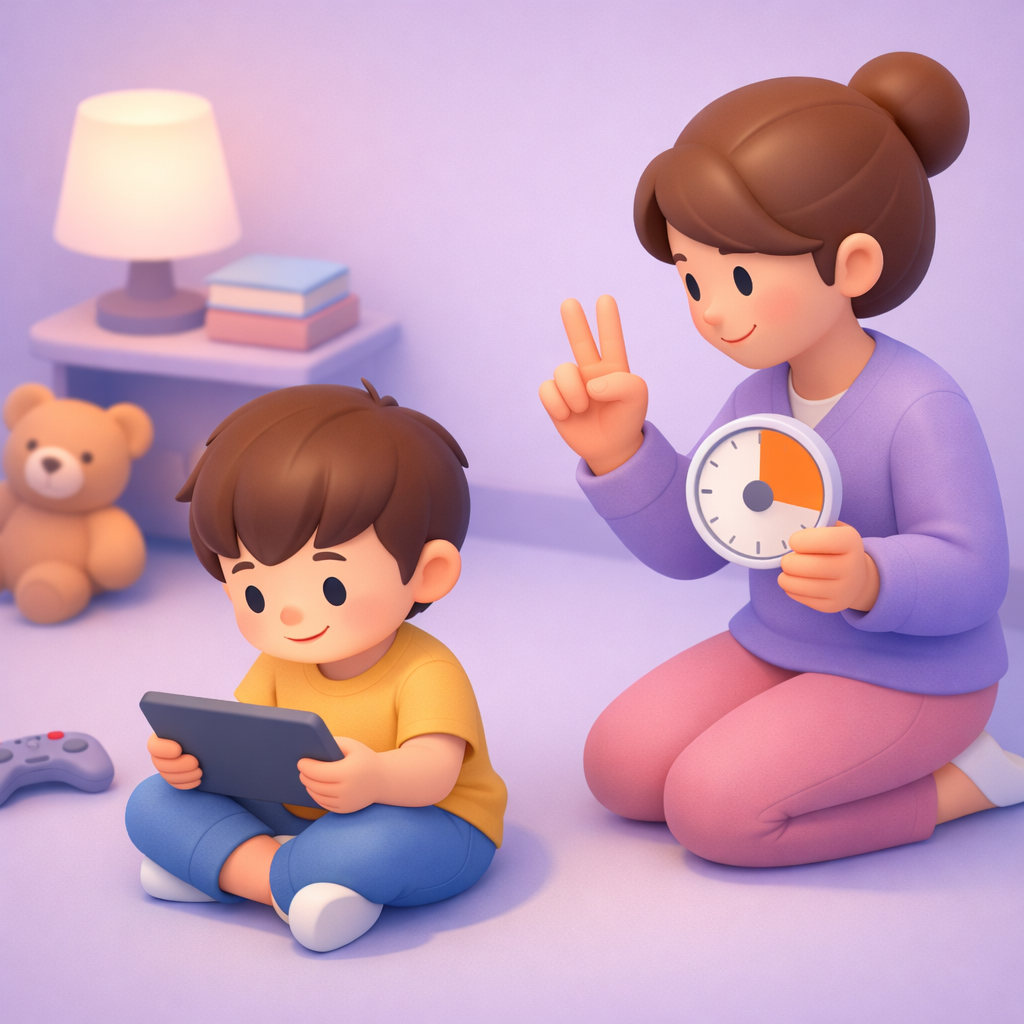
Because time is still abstract for young kids, external supports can make a big difference. Visual timers, sand timers, or simple kitchen timers help “show” time passing in a way words alone often can’t. Also consider technology-mediated transitions when possible (i.e., you can watch one episode of this show), as these may be easier for your children to conceptualize.
It also helps to remember that scaffolding takes practice. Especially for younger kids, timers work best when paired with reminders like, “You have five minutes left, then we’re getting ready for dinner.” It’s also helpful to give them multiple check-ins to help them grasp the passage of time: 10 minutes left, 5 minutes left, 2 minutes, 1 minute, done.
Over time, kids learn what these signals mean, and transitions become easier.
2. Build Smoother Transitions with Predictable Routines
Transitions are easier when kids know what to expect. Keeping “what comes next” consistent helps kids mentally prepare for the shift. For example:
- Screen time → snack
- Screen time → outside play
- Screen time → bedtime routine
It’s also important to consider when screen time happens. Transitions tend to be harder when kids are already tired, hungry, or emotionally overloaded. In those moments, even small frustrations can feel big.
Rather than avoiding screens, many families find it helpful to adjust timing. Choose screen activities that naturally wind down later in the day, or avoid high-engagement games during already tricky transitions like mornings before school.
3. Co-Engage When Possible
Co-engaging or co-playing gives caregivers valuable insight into what’s happening on the screen, so you can see:
- Where natural stopping points exist
- When a game round actually ends
- Why “five more minutes” may not make sense for certain activities
This understanding makes it easier to set realistic expectations and support smoother transitions. It also helps kids feel accompanied, rather than abruptly cut off.
Co-engagement doesn’t have to be constant to be effective. Even occasional involvement can help parents better understand the rhythm of the content their child is using.
4. Practice Emotional Regulation Skills Outside Screen Time
The emotional skills kids need during screen-time transitions are the same ones they use everywhere else. Think about other moments that are hard for kids:
- Sharing a toy
- Losing a game
- Putting down the crayons
- Hearing “no” to “just one more cookie?”
Screens don’t introduce new emotions, they just surface familiar ones in a digital context.
Practicing emotional regulation skills outside of screen time helps kids access those tools when screens turn off. Naming feelings, taking a pause, and calming down are skills that develop over time, through repeated, supported experiences.
5. Rebalance the Day When Transitions Become Extra Challenging
If screen-time transitions consistently lead to meltdowns, it can be helpful to zoom out and look at the overall rhythm of the day:
- Is my child getting enough sleep?
- Are screens happening during already difficult transitions?
- Are we balancing screen time with connection and unstructured play?
Often, small adjustments, like avoiding games before school, choosing shows with natural endings, or building in more downtime, can soften the emotional charge around screens. Replacing screen time with a different activity might not make a difference if it’s the overall structure or specific time of day that’s causing the struggle.
Look for ways to adjust schedules and environments to better suit your child and their developmental stage.
Screens Don’t “Cause” Tantrums, but Habits Matter
Screens don’t cause tantrums on their own. Most screen-time meltdowns are rooted in predictable developmental needs, difficult transitions, and how screens fit into a child’s daily rhythm.
With clear expectations, supportive routines, and practice navigating transitions, screens can be one of many activities kids learn to move in and out of without meltdowns becoming the norm.


