


 Copy Link
 Share
to X
Share
to X
 Share
to Facebook
Share
to Facebook
 Share
to LinkedIn
Share
to LinkedIn
 Share
on Email
Share
on Email
Most parents already know that teaching kids about money matters. You've probably read something about habits forming before age 7. You know you should start early.
What nobody tells you is what to actually say: in the car, at the checkout, when your 5-year-old melts down because you won't buy the toy. What words to use with a 4-year-old who can barely count to ten. What to do the morning after your kid blew through every dollar of their birthday money and now regrets it.
That gap (between knowing it matters and knowing what to do right now) is what this guide is for.
If you feel uncertain about your own money habits, or you’re worried you’ll teach the wrong things because nobody taught you well either, you’re in good company. Many parents feel exactly that way. You don’t need a perfect financial track record to give your child a great foundation. You just need to start the conversation.
Why money is genuinely hard to teach at this age (and why that's useful to know)
Before you try any of the strategies below, it helps to understand why money is a particularly tricky concept for young children. Not because they're not smart enough, but because of how their brains are developing right now.
Kids under 7 are still building three cognitive tools that money requires: impulse control (the ability to wait for something better later), abstract thinking (understanding that a card tap or a phone represents real value), and time perception (grasping that "save up for a week" is a concrete, achievable thing).
This is why the classic parent move of saying "we can't afford that" when your child spots something at the store often doesn't land the way you intend. To a 5-year-old who's watched you tap your phone at checkout a hundred times, it genuinely doesn't compute. The phone always works, so where's the "can't afford" part? Many young children quietly conclude that the ATM prints money on request, or that cards never run out. It's not a logic failure. It's just that the system is invisible to them.
Understanding this changes how you teach. You're not explaining a concept. You're making something invisible, visible. Once you see your job that way, the strategies below make a lot more sense.
What children can realistically understand at each age
Ages 3–4: Money is physical and interesting. Coins have different sizes and colours. Things at the store cost money. Grown-ups work to get money. This is enough. The goal at this stage is familiarity and exposure, not understanding value.
Ages 4–5: The exchange is starting to click. They can grasp that handing over money means you get less of it. They understand "this costs more than that" when shown side by side. Simple saving (coins in a jar they can see growing) makes sense and feels exciting.
Ages 5–6: Choices and trade-offs are within reach. "If you buy this, you won't have enough for that" lands at this age in a way it doesn't at 4. Short-term savings goals (a specific toy, a treat) are motivating and achievable. This is the age to introduce the three-jar system.
Ages 6–7: The concept of earning clicks. They can understand that extra effort (beyond regular responsibilities) connects to extra reward. Budgeting within a small amount ("you have $3, what do you want to spend it on?") is genuinely possible. Delayed gratification over a few weeks is within reach.
The practical takeaway: pitch your lessons at the right window. A conversation about saving "for the future" won't resonate with a 4-year-old. A conversation about saving for a specific toy she can point to will.
Start here: the spend, save, share method for ages 4–7
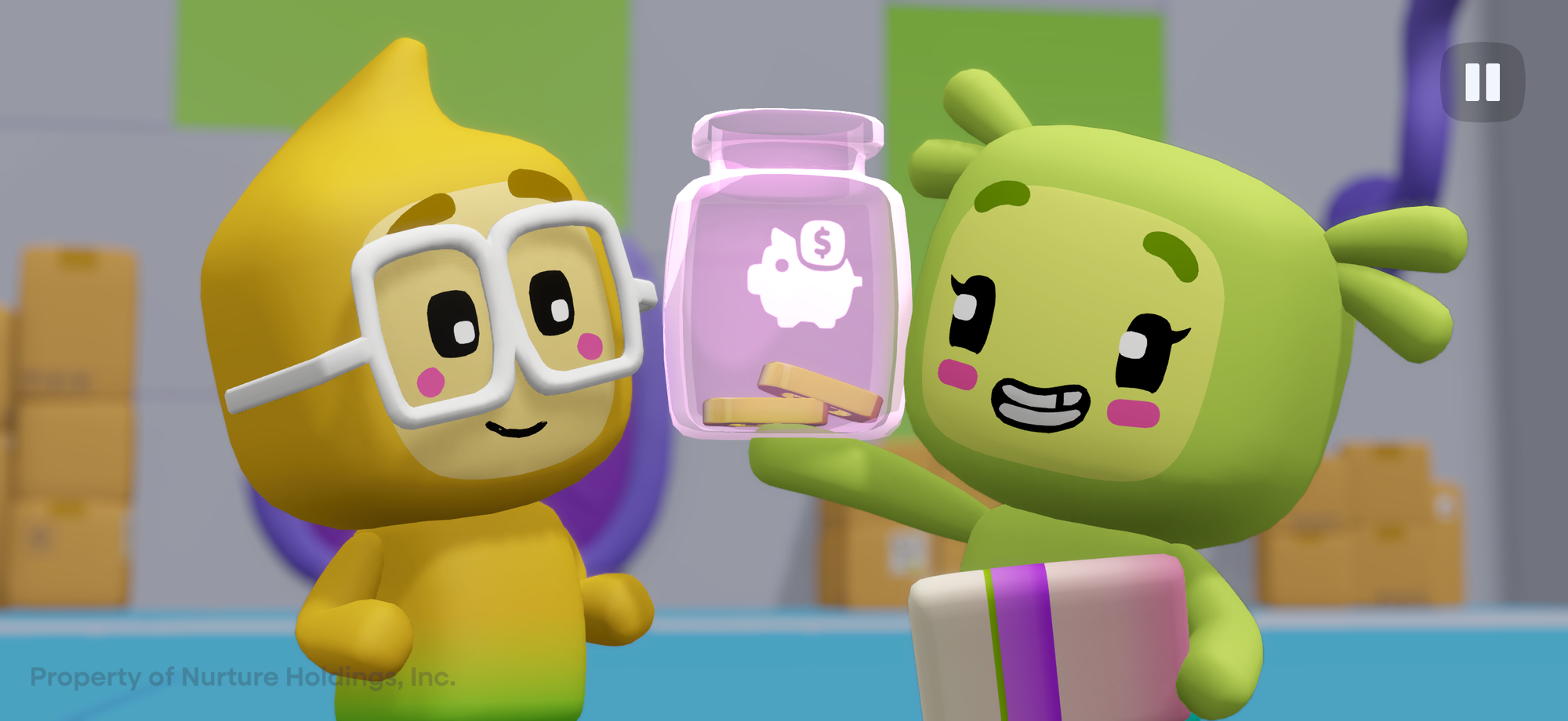
The most useful thing you can do this week, before any conversation or any book, is set up three jars.
Label them Spend, Save, and Share. That's it. The system exists in almost every culture's folk wisdom about money, and the reason is simple: it makes the abstract concrete. Children can see their money, touch it, sort it, and watch the jars change over time. For the age group we're talking about, that physical reality is essential.

Here's how to introduce it without making it feel like a lesson:
Let them choose the jars. Go to the store and let your child pick three containers. Mismatched is fine, decorated is better. When they own the jars, they care about what goes in them.
Use their words. Instead of "this is your savings account," try: "This jar is for things you want later. The longer you leave it, the bigger it gets." Instead of "charitable giving," try: "This one is for someone who needs it more than us. We'll decide together who."
Don't prescribe the split. Ask your child what they think is fair. A 5-year-old who decides to put half in spending and half in saving has learned more than one who's been told the percentages. Guide gently if the split feels very off, but resist the urge to control it. For age-specific splits and the full setup walkthrough, see our complete guide to money management for kids.
What to do the day after they blow through it. This is the moment most parenting guides skip. Your child spends their entire spend jar on something they now regret. The instinct is to rescue them, or lecture them, or top it up. Don't do any of those. Instead: "How does that feel? What would you do differently next time?" Then wait. The feeling of an empty jar, held calmly and with curiosity rather than punishment, is worth a hundred explanations.
A note on the save jar: for young children, saving needs a target. "Save your money" is abstract. "Save your money until you have enough for the Lego set you showed me" is a plan. Put a picture of the target on the save jar. That picture does more motivational work than any speech. For a deeper dive on saving specifically, including how to handle the 'I want to spend it all' moment, see our guide on teaching kids about saving money.
Teaching money through everyday moments (no setup required)
Here's the thing most parents miss: the best financial education doesn't happen at a desk. It happens in the car, at the checkout, in the supermarket aisle. The daily moments you're already living through are better classrooms than any structured lesson. You just have to use them.
At the grocery store: Instead of quietly making decisions, narrate them. "I'm choosing this one because it's the same thing but costs less, which means we have more money for something else later." Or: "We need bread and milk first. Those are needs. The cookies are a want. We might get them, but needs come first."
Even better: give your child a small job. "You're in charge of finding the best-value pasta." Let them hold the options and decide. The moment of choosing, with real stakes, teaches more than watching you choose.
When they ask for something you're not buying:
Stop saying "we can't afford it." It's not that the phrase is wrong (sometimes it's true), but as a reflexive response it teaches nothing, and for children who sense financial stress at home, it can quietly build anxiety about money rather than confidence.
Try instead: "That's not how we're choosing to spend our money today." Or: "That could go on your save list. How many weeks do you think it would take?" Or simply: "Not today. But I heard you, and I know you'd like that."
The difference isn't just semantic. The first version closes the conversation. These versions open it and turn a moment of frustration into a five-second lesson in trade-offs.
The Tooth Fairy / birthday money moment: This is one of the richest teaching opportunities parents regularly miss. Before the money lands in their hands, have the conversation: "You're going to get some money. What do you want to do with it?" Not after the money lands in their hands, when the excitement has already made the decision, but before, when they can think. Guide them toward at least splitting it: some to spend now, some to the save jar.
When you pay a bill: "I'm paying for our internet right now. That's how we get to stream shows and how you play your games." That's enough. You don't need to explain the full household budget. Just demystify one transaction. Over time, those moments add up to a child who understands that things cost money and money comes from somewhere.
The card/phone question: At some point, probably soon if it hasn't happened already, your child will ask why you don't use coins, or why the phone "gives you things for free." This is one of the most important conversations to have well.
Try a simple diagram: draw a line from “work” to “bank” to “card/phone” to “store.” “When I go to work, they put money in the bank. The card talks to the bank. When I tap the card, real money leaves our bank. It’s not free, and it’s not a source of new money — the card is just how you carry money you’ve already earned. It’s invisible, not magic.” For a 5-year-old, this is genuinely illuminating. The phone isn’t magic. The bank isn’t a fountain. Your money is finite, and the card is just how you carry it.
Why play teaches money concepts better than explanations (and what to play)
At ages 4 to 7, children learn by doing, not by being told. This isn't a philosophical preference; it's developmental reality. Abstract concepts like delayed gratification, trade-offs, and value don't stick through explanation alone at this age. They stick through experience: making a decision, feeling the result, and processing it with a caring adult nearby.
Play creates a safe version of that experience. The stakes are low enough that mistakes don't hurt, but real enough that the feelings are genuine.
Pretend play is the most powerful starting point. A play grocery store with price tags and play money isn't a game. It's a rehearsal for real decisions. Setting up "the shop" together (let your child price the items, and watch what they decide things are "worth") and then taking turns as customer and cashier introduces exchange, value, and decision-making before any real money changes hands.
Toy cash registers, play money, and even sticky notes with numbers on them are all you need. The fancier the setup, the less it matters. What matters is that the child is making choices and experiencing consequences inside the fiction.
Board games have a role, but know their limits. Games like Monopoly Junior and The Allowance Game introduce spending and saving in a fun format. Their limit at this age is that they tend to be competitive rather than cooperative. The goal is to beat other players, not to build something together. That's not a dealbreaker, but it is worth noting.
Digital adventures built around financial decisions bring something physical play can't easily replicate: a story that makes the emotional stakes feel real. Nurture's Scooter Park Fun! adventure does something particularly interesting for this age group. In the adventure, Chirp and Fizz face a genuine budget problem. They want to build a scooter park, but neither of them has enough coins to afford the pieces alone. The solution isn't just "save more." It's to pool their Fluffle Coins together. Children playing this adventure aren't told that saving together can achieve what saving alone can't. They experience it: making the spending decisions, choosing which pieces to buy, and seeing the scooter park take shape.
That concept (that resources pooled together create shared things nobody could build alone) is one the best institutional content in this space doesn't touch. And it's a concept worth your child having, well before they're old enough to vote for public parks.
For a full roundup of games and tools for this age group, see our guide to financial literacy games for kids.
Four mistakes parents make when teaching kids about money
These aren't meant to make you feel bad. They're patterns that come up constantly in parent discussions, and recognising them is genuinely useful.
1. Saying "we can't afford it" as a default As covered above, it's not that this is always wrong. It's that as a reflex it teaches nothing and can quietly install a scarcity mindset. The better default is a version that opens a conversation: "Not today" or "what would you want to save up for that?"
2. Paying for basic chores The research and community consensus on this is surprisingly strong: paying children for everyday household contributions (setting the table, tidying their room, feeding the pet) confuses two things that should be separate. Contributing to the family is citizenship, not commerce. If payment gets attached to it, children may gradually stop helping unless they're being compensated. Instead, pay for "above-and-beyond" tasks: things outside the normal family expectations. This preserves both the work ethic lesson and the family-contribution ethic.
3. Waiting until they're "ready" The neurological window for forming money habits runs roughly 3–7. Many parents wait until their child seems "old enough to understand," which often means 8 or 9 or older. By then the habits, good and bad, are largely in place. You don't need to wait for readiness. You need to pitch things at the right developmental level for right now, which this guide is designed to help with.
4. Making money feel stressful Kids absorb emotional tone more reliably than they absorb information. If money conversations in your house are tense, whispered, or shot through with anxiety, your child is learning that money is dangerous, regardless of the content of what's being said. The goal isn't false cheerfulness. If money is genuinely tight, honesty is better than pretence. But a calm, matter-of-fact tone around money teaches children that money is manageable, which is arguably the most important financial lesson of all.
Your week-one plan
You don't need to do all of this at once. Here's a grounded, low-effort starting point:
This weekend: Set up the three jars together. Let your child pick them, decorate them, label them. Put whatever coins or small notes they already have inside and split them. They lead, you guide.
This week: Find one moment in daily life to narrate a money decision out loud. Grocery store, checkout, paying a bill. Anything. One sentence is enough: "I'm choosing this because..."
When the moment comes: The next time your child asks for something you're not buying, try the reframe. "Not today, but what if we put it on your save list?" See what happens.
That's three things. One weekend, one sentence, one reframe. Start there.

A six-page parent's companion to Scooter Park Fun! The four money moments your child will play through, the exact question to ask at each one, and three quick activities to try after the screen goes off. Free, no email needed.
Or open Scooter Park Fun! in the Nurture app to play it together tonight.
Frequently asked questions
What is the best age to start teaching kids about money? Research from the University of Cambridge suggests that money habits begin forming before age 7, making the 3–7 window the most important one for establishing healthy patterns. You don't need to start with formal lessons: exposure, narration, and play are enough in the early years. The key is consistency over time rather than any single "money talk."
What are the best ways to teach kids about money? For ages 4–7, the most effective approaches combine three things: making money physical and visible (jars, coins, cash), narrating your own financial decisions out loud, and using play to let them practise decisions with low stakes. Formal lessons, worksheets, and abstract explanations are far less effective at this age than lived experience and casual conversation.
What is the 50/30/20 rule for kids? The 50/30/20 rule (50% needs, 30% wants, 20% savings) is typically recommended for older children and teenagers who are managing allowance or income of some size. For ages 4–7, a simpler three-way split (spend, save, share) is more developmentally appropriate. The percentages matter less than the habit of dividing money at all. Let your child choose their own split first; guide gently from there.
Should I give my child an allowance? An allowance gives children the single most important thing money education requires: real money to make real decisions with. The research consistently supports giving children an allowance, but ties it to learning rather than chores (see the chores note above). The amount matters less than the regularity and the conversations attached to it. Even small amounts (a dollar a week for a 5-year-old) create enough real-world decision moments to be valuable.
My child thinks money comes out of the ATM for free. How do I explain it? This is one of the most common questions parents have, and almost no mainstream advice addresses it directly. A simple diagram works well: work → bank → card → store, with the explanation that the card is how you carry money you've already earned, not a source of new money. "When I tap my phone, real money leaves our account. The bank keeps score." Visiting a physical bank together (to make a deposit or just to see the space) can make the abstract system feel more real.
What do I say instead of "we can't afford it"? "We can't afford it" isn't wrong, but as a reflex it teaches nothing and can quietly build anxiety. More useful alternatives: "That's not how we're choosing to spend our money today" (teaches that spending is a choice, not a limitation); "What if that went on your save list?" (turns refusal into a plan); or simply "Not today, I heard you, you'd like that" (acknowledges the want without making money feel shameful). The goal is to keep the conversation open rather than closing it.


